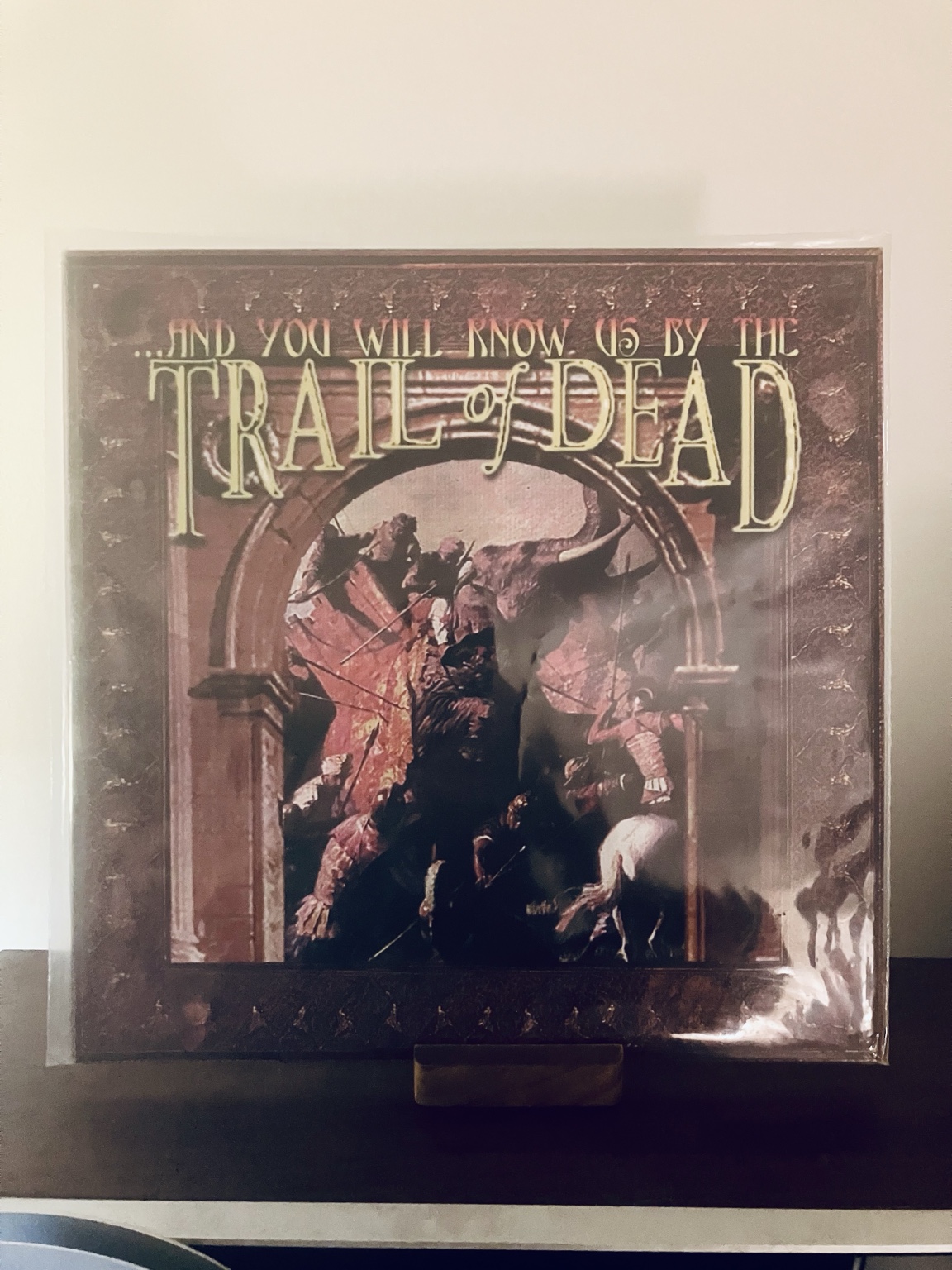
12 years ago, I reviewed this album on Reddit. I’m reviewing it again because, as I get older, this album continues to grow on me—and it’s worth talking about again as I once again try to reviews the best albums of all time.
But nevertheless, let me quote something I said all those years ago:
What I heard was revelatory. …Trail of Dead was harder, faster, angrier than any other punk band I’d heard till that point – but more importantly, they had something important to say.
All this remains true.
I first discovered this album whe I was 17-years-old. I bought it unheard. All I knew was that the cover featured an elephant in the heat of battle, and that was reason enough to buy.
When my parents weren’t home, I went downstairs and put the disc on the family HiFi centre.
And this day, the opening to this album has to be the greatest debut song ever.
The song was “Richter Scale Madness”, and the name delivered. Those drums are so explosive, they put Keith Moon to shame. Just hearing those rolls is enough to give one a heart attack—and they don’t let up.
So if you deliver the most energetic and fiery song possible on the first try, where do you even go from here?
Pack it up! Punk rock is done!
But wait… this album has actual contrast.
There’s everything a teenage punk wants: aggression, nihilism, violence, disillusionment, and sheer naked impulse.
And then there’s what a teenage punk doesn’t know he needs: vulnerability, the hunt for meaning, making sense of all the chaos. There’s an inwardness sadness to the songs here, not just outward anger. And that’s important because anger without sadness lacks awareness.
The song after “Richter Scale Madness” is called “Novena Without Faith”. And what even is that?
I had to look up the word. Apparently, it’s a traditional Christian devotion consisting of prayers offered over nine days or on nine occasions. And so the title is a contradiction: how do you perform a religious ritual without devotion?
Is it even possible to desire the things religion promises, such as transcendance and resolution, if you cannot believe?
This is where TOD goes beyond punk rock’s typical subject matter and moves to something that is delicate, slowly builds, until it absolutely soards everything—piano, guitar, bass, drums, vocals—washes over you.
I am tempted to do an analysis of all eight songs on this album—and I can—but they will never do justice to actually hearing them. Nevertheless, decades later, every song on this album gives me goosebumps. The emotion has never gone away.
Hearing this band again, I can’t help but realize how much they’re misunderstood.
Recently, someone told me they were part of the garage rock revival of the early 2000s. And yet, just a cursory listen to this first album reveals this is not the case.
Nothing is being revived here. There’s no nostalgia. There’s no call-outs to the 50s, 60s, or 70s—the supposed heyday or rock.
No, this is post-hardcore in the truest sense in that the first song takes hardcore to its natural conclusion by throwing everything but the kitchen sink at you. And then, when you’re so overwhelmed by the ruckus—feel that nothing can truly follow it up—they deliver something that a revivalist actually can’t offer: progress.
When I first heard this album, I was dipping my toe into emo. As a kid who was quickly tiring of the likes of NoFX and 88 Fingers Louie. I was quickly tiring of grown ass men pretending they were in high school.
To this day, I thought this was where emo should go, even though it wasn’t actually emo. I nevertheless thought it was time for punk rock to explore ideas big ideas in an expressive manner.
Certainly, this isn’t emo. It’s something better. It’s rock n’ roll expressionism.
Some Jackson Pollock to go with your Bo Diddley.