As I mentioned yesterday, by the time indie sleaze became a cultural phenomenon, one of the bands responsible for its very existence had become an afterthought.
A.R.E. Weapons spent the early 2000s being castigated by music critics for everything from their celebrity connections to their apparent lack of musical substance. Their self-titled debut famously received a 1.5/10 from Pitchfork. Their follow-up, Free in the Streets, saw them abandon much of their irony and theatricality following the death of guitarist Ryan Noel in 2004.
Now, I’ll admit that their first two albums weren’t particularly great. And I say this as someone who had followed the band since before they were even called A.R.E. Weapons. By 2005, even I was ready to give up on them.
There’s a reason I’m skipping those first two albums: I want to focus on what’s great. And just when I was ready to give up on the band, a funny thing happened.
A.R.E. Weapons got good.
It’s actually quite ironic. Just as indie sleaze started catching fire, A.R.E. Weapons became completely invisible. Every college campus was teeming with hipsters wearing trucker hats and American Apparel, reading Vice, smoking American Spirits, and sporting “ironic” moustaches—all part of an aesthetic that A.R.E. Weapons helped pioneer.
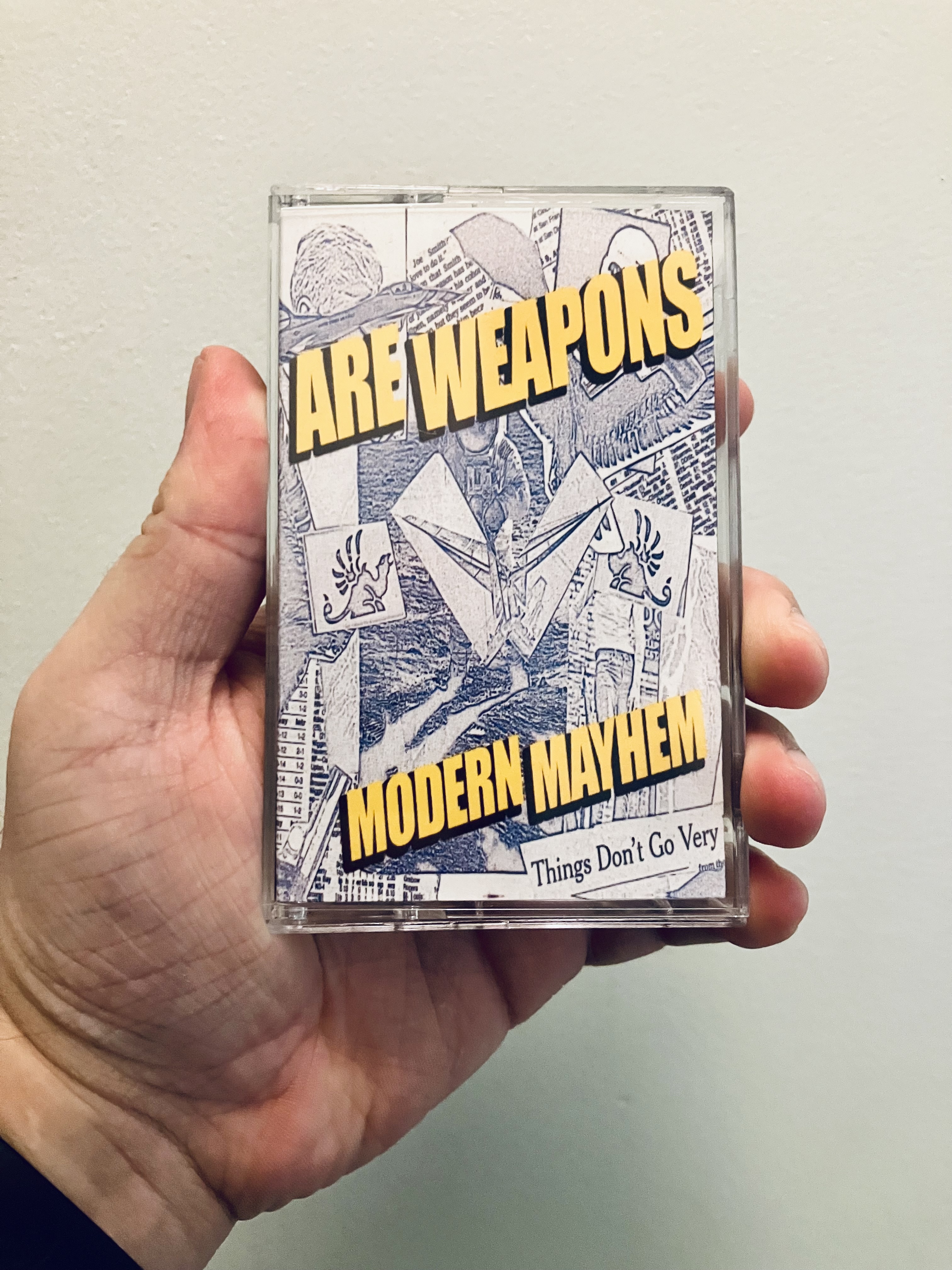
And in 2007, that’s when they released Modern Mayhem. Every song on here is good. Not a single dud.
Top to bottom, this is a superb punk album.
Punk mostly hates synths. I say mostly because there’s also a tradition of punk bands doing the most punk thing they can ever do: embracing them. For example, The Stranglers and The Normal. But funnily enough, it goes back even further to one of the first bands to ever self-identify as punk: Suicide.
So the notion that synthesizers are somehow antithetical to punk is historically backwards. Synths were there before the Ramones were even a band.
That’s where this album draws most of its influence. But while Suicide famously stuck to synths, drum machines, and vocals, A.R.E. Weapons feature an interplay between guitars and synths, with each building upon the other.
And this is punctuated by Brain McPeck’s earnest, almost naïve “aw-shucks” delivery—almost like a kid who’s discovered trouble.
The result is the humour of “Let’s Go To Times Square”. This is an invitation to all kinds of trouble in one of Manhattan’s most famous neighbourhoods: travelling by train, smoking a blunt, watching some NFL.
The straight-up garage rock of “Weird Wild Free” feels celebratory. As the title implies, it’s about the pull of freedom. And it’s got a simplicity that would make The Ramones blush.
And this is contrasted with the despondence and frustration of “Have You Ever?” The rhythm is reminiscent of a heartbeat. For me, this is the vocal highlight of the album. McPeck discards typical punk rock shouts in favour of an animal-like howl. It’s here that we hear the Suicide influence most prominently.
Had “Have You Ever?” been my introduction to Modern Mayhem, I probably would’ve had a very different impression of the album. But the song that brought me back to A.R.E. Weapons was arguably one of their most infectious.
On a lark, I did a search for them on YouTube after remembering the Pitchfork reviews. And I came across the music video for “F What You Like”.
And this made me remember what I liked about A.R.E. Weapons in the first place, back when I first heard about Ayler’s Angels and had dreams of making it out to New York—which I eventually did.
The reason I love this band is that they’ve always tried to make something dirty and violent that’s somehow still danceable—something that makes you tap your feet.
Too many punk rock bands are afraid of dancing. Or they get too caught up in a template, the orthodoxy of a scene, or the politics of “selling out”. And too few of them make things on their own terms.
For a genre of music that’s ostensibly about breaking rules, punk sure has accumulated a lot of them. And there’s something particularly absurd about the idea that music loses its aggression the moment it makes you want to dance.
But consider A.R.E. Weapons. Away from the glitz and the sleaze, these guys were just trying to make good, honest punk with synths. Without shenanigans, that’s what they do. It became one of my favourite punk albums ever.
After my first listen, I immediately bought the album on iTunes. It was one of the first albums I’d ever bought off iTunes, too, because you couldn’t even find the album in stores or on BitTorrent. Totally worth it. I still listen to it to this day.
Gavin McInnes once called A.R.E. Weapons a “magazine band” because he felt they were built for magazine profiles, not music. But considering their later discography—as well as TV Baby—he’s plain wrong.
Because once they were no longer in the press, A.R.E. Weapons became a band worth listening to, and Modern Mayhem is a case in point.