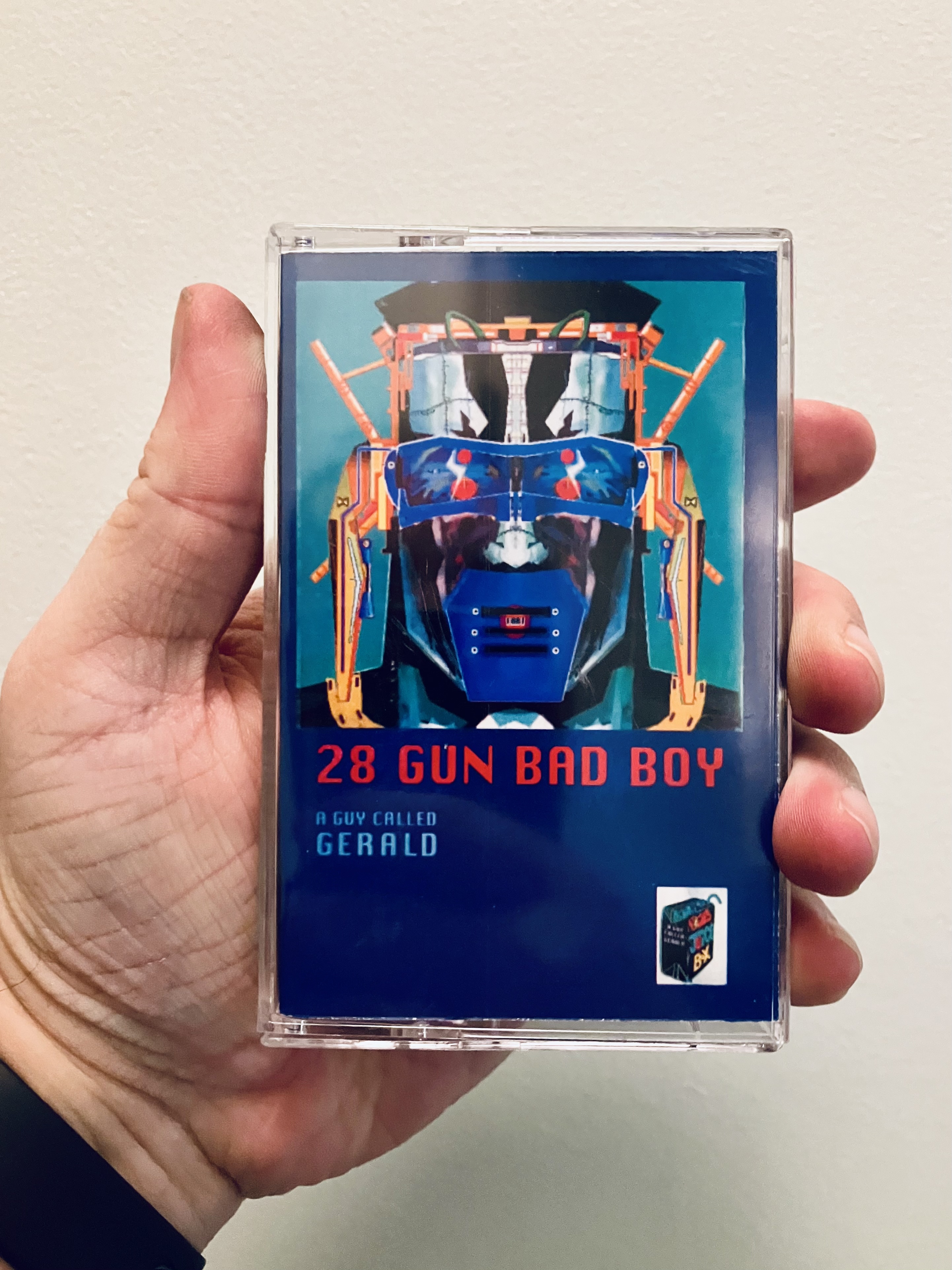
Arguably, this is the first ever jungle album of all time.
With that out of the way, let me explain how A Guy Called Gerald went from being one of the chief innovators of acid house with the single “Voodoo Ray” to this—because it’s quite a jump!
There was something else going on in Manchester
Gerald came out of Manchester, which—let’s not forget—was also the home of post-punk outfits Joy Division and The Smiths. Hell, “Voodoo Ray” was featured in the movie 24 Hour Party People as well as on its soundtrack.
But something else was going on in Manchester, specifically in the Black community. A unique electronic culture was developing that took elements of hip-hop, electro, funk, reggae, and dub—and put them all in a blender. Even before “Voodoo Ray”, Gerald was recording hip-hop with MC Tunes as the Hit Squad.
Nevertheless, working first with 808 State and then going solo, Gerald made his name in acid house.
Yet he didn’t stay there for long. By 1989, he was already experimenting with breakbeats on the song “Specific Hate”.
From acid house to working out some aggression
What apparently prompted the abrupt change was anger about the music industry. After signing with CBS/Columbia, he became frustrated with his label. And even worse, he was stuck in a dispute over songwriting credits for 808 State’s “Pacific State”. So he started working out all that aggression in his new songwriting.
Attending Fabio and Grooverider’s Rage club night in London, Gerald encountered more experimental forms of breakbeat hardcore. He would then return to Manchester and incorporate those ideas into his own work. Eventually, he decided to go independent with his own label, Juice Box Records.
Every bit as revolutionary as Unknown Pleasures
And the result was 28 Gun Bad Boy, which—while it may not get its just due in the mainstream press—is no less revolutionary an album than Unknown Pleasures by fellow Manchester artists Joy Division.
Because this really did revolutionize breakbeat programming. Gerald wasn’t content with just sampling drum breaks. He chopped them up, rearranged them, and layered them into complex polyrhythms. Quite likely, he was the first to subvert hardcore’s established drum patterns.
In making this album, he also established the blueprint for a subgenre of jungle: ragga jungle. You can hear this on the first track, “Mix”, which actually has multiple parts. And on the sixth part, “Ses Makes You Wise”, that Jamaican influence shines through.
What you pick up when recording jungle onto cassette
Nevertheless, what does this album sound like?
It’s funny: when you record an album yourself onto cassette, you pick up things that aren’t readily apparent on a casual listen. For example, “Mix” is quite compressed. So compressed that most people just dismiss it as badly recorded.
But we get just a little bit more dynamic range on the second song, “Money Honey”. And by the time we close out Side 2, the beats pulse vividly and we get that expanded sound.
What I also appreciate is the deep sub-bass. Nowadays, we take this for granted. However, in the early ’90s, there was a transition from the prominent gated-reverb drum sounds of the ’80s towards the modern era, where bass is more emphasized. I am very happy I chose a Type I cassette to record this on.
As the album goes on, 28 Gun Bad Boy reveals more and more layers in the transformation from breakbeat hardcore to jungle. So much of this might sound like it’s a product of its time. But the reason it sounds like a product of its time is that this album was among the first to feature these sounds.
Where the hell was I in 1993?
Now, I didn’t appreciate any of this when 28 Gun Bad Boy was current. My 12-year-old self was still trying to process alternative music and couldn’t believe something had just eclipsed hair metal. How could I even consider the beginnings of rave culture—which, to a kid living in Vancouver, was as alien as it gets?
Actually, I didn’t even attend a rave until the latter part of the ’90s. Jungle itself only reached my ears during my last year of high school, at the end of 1999.
That’s how ahead of the curve 28 Gun Bad Boy was. Because even as a teenager, I really was trying to keep as up to date as possible with music. Yet this album totally passed me by.
I guess I wasn’t ready for that yet
There’s a scene in Back to the Future where, after performing “Johnny B. Goode” at the high school dance in 1955, Marty McFly says:
“I guess you guys aren’t ready for that yet. But your kids are gonna love it.”
I suspect if I’d heard 28 Gun Bad Boy in 1993, I wouldn’t have been ready for it. Compared to what I was hearing, it was simply too out there. But as a 45-year-old man, I sure do love it now.
I suspect it’s precisely because 28 Gun Bad Boy was so ahead of its time that it doesn’t get the accolades it deserves.
Another reason is that Gerald’s follow-up was Black Secret Technology—which is an even better album. And I’m going to review that tomorrow.